
By: Hamid Mir
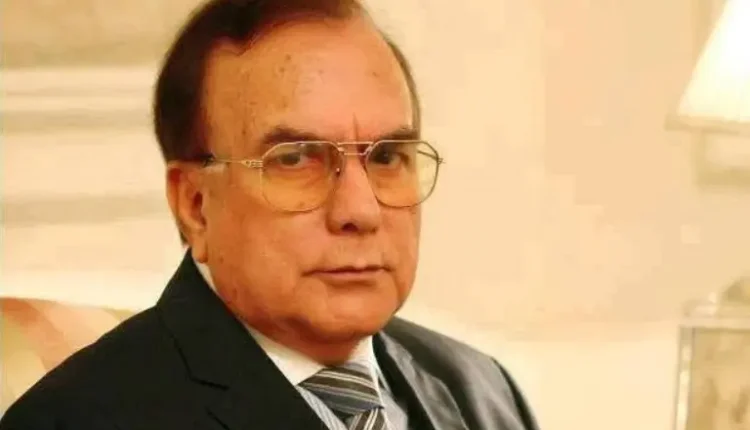
Mian Manzoor Ahmad Wattoo’s life was defined by striking coincidences and enduring political turbulence. Two dates stood out above all others: August 14, the day of his birth, which coincided with Pakistan’s Independence Day, and December 16, 2025, the day of his death—the same date Pakistan witnessed the traumatic dismemberment of the country in 1971.
Wattoo served twice as Chief Minister of Punjab, Pakistan’s largest province. On both occasions, efforts to remove him from office through the imposition of governor’s rule ultimately failed, underscoring his political resilience. His autobiography, Jurm-e-Siyasat (The Crime of Politics), offers a rare insight into his life and times. He began writing the book 26 years before his death while in prison and completed it in December 2000 in Room No. 4 of the Punjab Institute of Cardiology, Lahore.
The autobiography opens with a foreword by former prime minister Benazir Bhutto. She had appointed Wattoo as Chief Minister of Punjab and later imposed governor’s rule to remove him. When Wattoo later became her political ally, he requested her to write the foreword, in which she noted that despite frequent political disagreements, mutual personal respect between them always remained intact. After Benazir Bhutto’s assassination, Wattoo formally joined the Pakistan Peoples Party (PPP), a move facilitated by Asif Ali Zardari.
Wattoo was widely regarded as a self-made politician of Depalpur rather than a traditional feudal figure. Born in the village of Muazzam in Ferozepur district of Indian Punjab, he migrated to Pakistan after Partition. He began his political career at the union council level and rose to become Chief Minister of Punjab, an ascent he often described as the result of perseverance rather than privilege.
The political climate of the 1990s, particularly during his tenure as chief minister in 1994, was marked by intense confrontation. At the time, Benazir Bhutto was Prime Minister, while Nawaz Sharif led the opposition. During protests on Lahore’s Mall Road, clashes between police and Pakistan Muslim League-Nawaz (PML-N) workers resulted in injuries and arrests, including that of senior leader Javed Hashmi. The situation escalated further at Regal Chowk, where police resorted to tear gas and aerial firing after Nawaz Sharif’s arrival reignited protests.
These events triggered a bitter political and media controversy. Conflicting narratives emerged over whether police had fired directly at protesters or whether injuries were caused by firing from within the crowd. Wattoo’s government reacted strongly to critical reporting, leading to pressure on media organizations and the reassignment of journalists amid mounting tensions between the provincial government and the press.
Wattoo’s rivalry with Nawaz Sharif spanned decades, alternating between cooperation and conflict. Both were members of the Punjab Assembly for the first time in 1985 during General Zia-ul-Haq’s era—Nawaz Sharif as Chief Minister and Wattoo as Speaker of the Punjab Assembly. In 1993, Wattoo engineered Punjab’s first successful vote of no confidence, removing Ghulam Haider Wyne and assuming the chief ministership himself. Later, during Nawaz Sharif’s second term, Wattoo was arrested on allegations of misuse of funds at Punjab House, Islamabad—an action widely viewed by his supporters as politically motivated.
In February 1999, Wattoo was again arrested on corruption charges. After General Pervez Musharraf ousted Nawaz Sharif’s government in October 1999, Wattoo spoke openly about his time in prison, noting that he had closely followed political commentary and criticism of government policies from behind bars.
In 2008, Wattoo returned to federal politics as Minister for Industries and Production, remaining an influential figure until his later years. Those close to him often referred to him as a benefactor and mentor, a description he accepted with a quiet smile.
Perhaps the most reflective passages of Jurm-e-Siyasat deal with solitary confinement. Wattoo described the isolation of prison life as emotionally unbearable yet intellectually transformative. He wrote that moonlight, starlight, and companionship with books offered solace, turning solitude into an opportunity for introspection and self-correction—a “refresher course” for life.
His words resonate powerfully in Pakistan’s political history, where many leaders—from presidents and prime ministers to senior ministers—have experienced solitary confinement at different points in time. Yet, as Wattoo’s life demonstrated, imprisonment rarely diminished their political resolve.
Mian Manzoor Ahmad Wattoo’s journey—from a migrant child to chief minister, from prison cells to the corridors of power—remains a compelling chapter in Pakistan’s political narrative, marked by paradox, persistence, and profound reflection.